For years, mobile game growth followed a familiar model: acquire users, retain them, and then monetize through ads or in-app purchases.
Now that model is becoming harder to sustain. Installs across many genres have plateaued, user acquisition costs are rising, and studios are competing for a limited amount of player attention (and spend). Success increasingly relies on what happens after a user installs the game; how long they’re retained and how deeply they engage over time.
As a result, studios are looking more closely at how to increase user lifetime value (LTV). When players show loyalty through continued engagement, existing monetization systems perform better as well.
Embedded rewards, like those powered by ZBD Earn, are one approach that has shown consistent results across all these areas to help drive growth.
How embedded rewards work
ZBD Earn adds real-money rewards directly into the game. They are embedded in the game’s UI, tied directly to progression, and payouts are handled in-game instead of through external tools or platforms. This makes rewards feel like a natural part of the gameplay experience, rather than layered on top like offerwalls or reward apps.
Here’s an example of how it works:
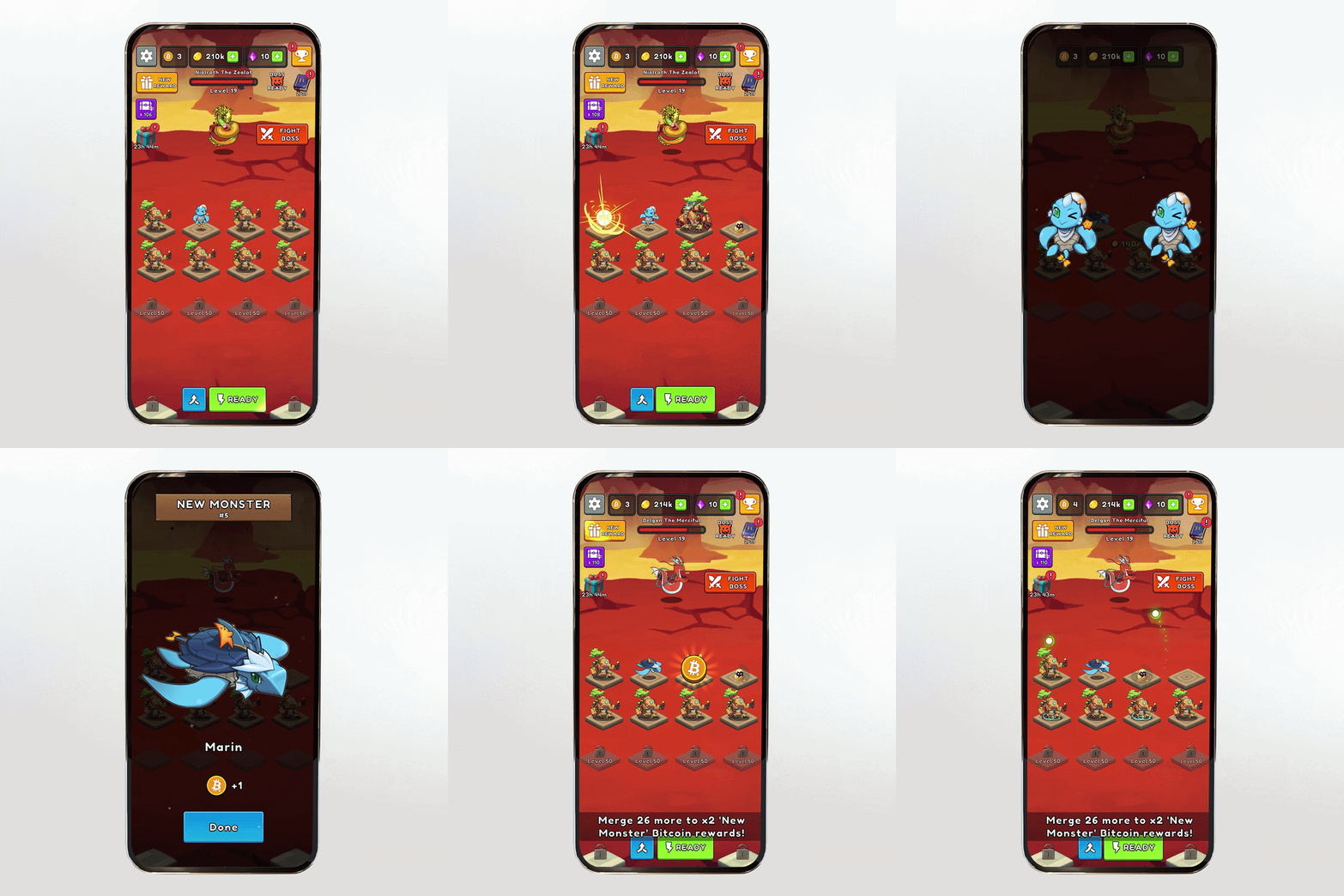
Rewards are always tied to gameplay mechanics and actions to ensure users earn them by progressing through the game, not just for showing up. That includes completing first-time user experience progression, milestones, challenges, and more. But one of the most important capabilities: embedded rewards give studios configurability options. They can tailor rewards across different user segments based on acquisition source, engagement patterns, retention stage, or monetization behavior.
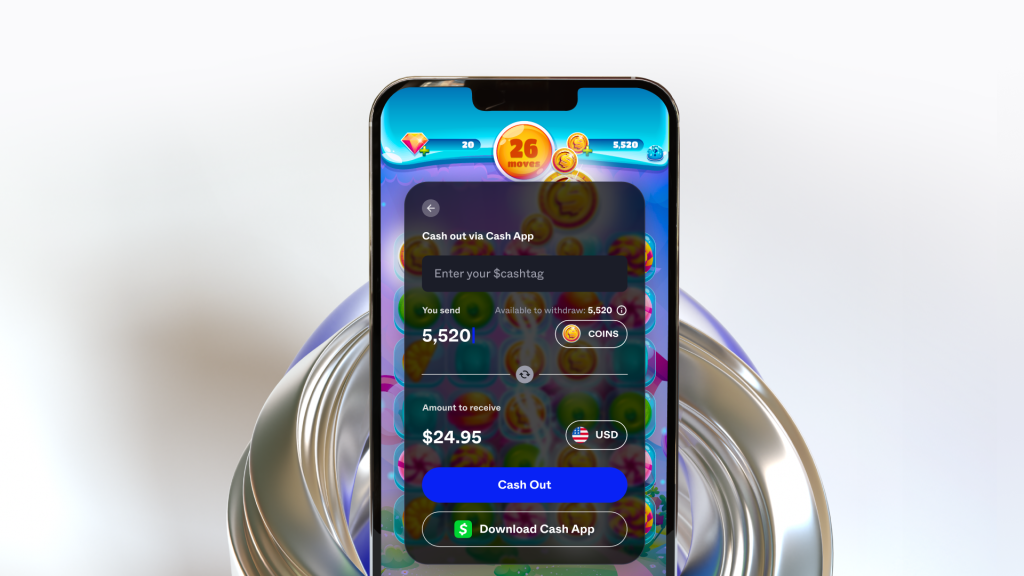
Once users earn rewards, they can withdraw them through the in-game cash-out flow, connecting gameplay progress with real-world value. Read more about how ZBD Earn works.
Retention moves first
Typically the first metric to improve after introducing embedded rewards is retention. Titles including Fumb Games’ Merge Monsters and Bitcoin Miner saw significant improvements in retention when integrating ZBD Earn.
Check out the chart showing retention performance:
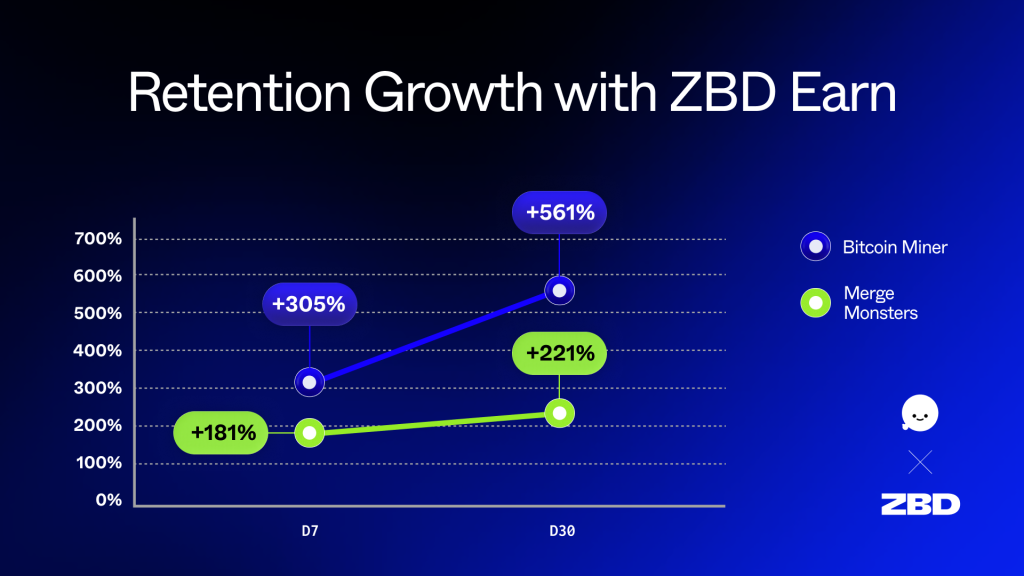
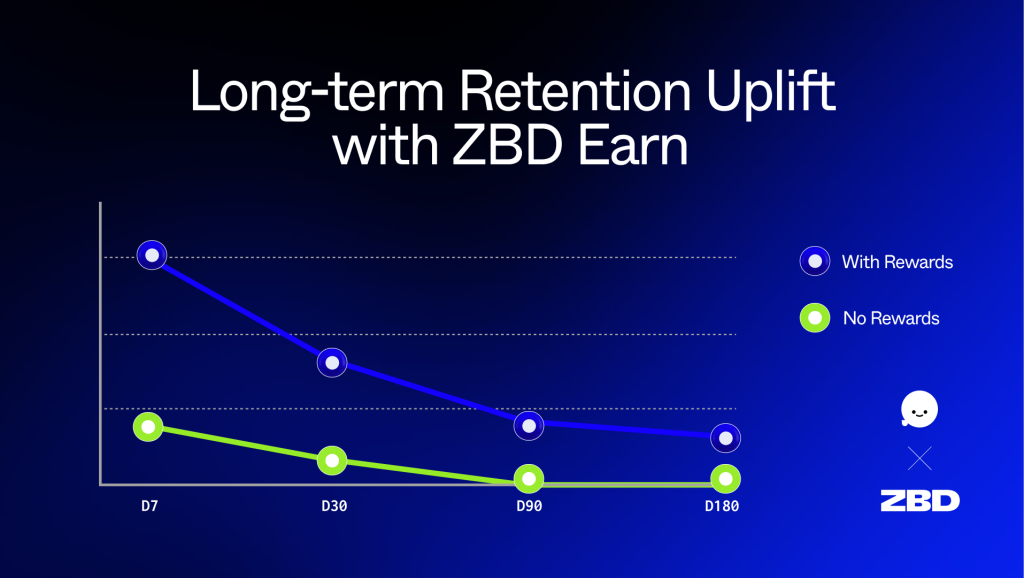
Both games show significant retention gains from D7, with an even more pronounced lift at D30. Bitcoin Miner reached over 4x retention at D7 and more than 6.5x at D30, while Merge Monsters saw ~2.8x retention at D7 and 3.2x at D30. This points to a deeper impact on long-term engagement rather than short-term behavior.
Often, the impact of real money rewards extends even beyond D30. In one of the titles, the relative lift in retention persists through D180 with nearly 4% uplift compared to the baseline.
So let’s take a step back, and look at the reasons why. Some in the industry, such as TapNation’s Philippe Lenormand, have described this shift as a move toward a value-for-time economy. Users know their attention has value. And games know it too. To win their attention, games need to be compelling. Tying gameplay to real-money rewards gives users FOMO; they know if they stop playing, they’re leaving real money on the table. When a user’s in-game progress is tied to a real money reward, the opportunity cost of leaving increases. Embedded rewards build loyalty by aligning player time with value for both players and developers, creating a strong win-win scenario.
What follows? Engagement and monetization improve
Retention improvements naturally evolve into deeper engagement within the game. When users retain better and session frequency and duration increase, they interact more with the core gameloop and monetization systems. As a result, ad interactions see a boost too.
There is also a behavioral shift. Instead of feeling like interruptions, ads and engagement triggers start to feel reciprocal. Users are participating in a system where their time and attention generate real-world value.
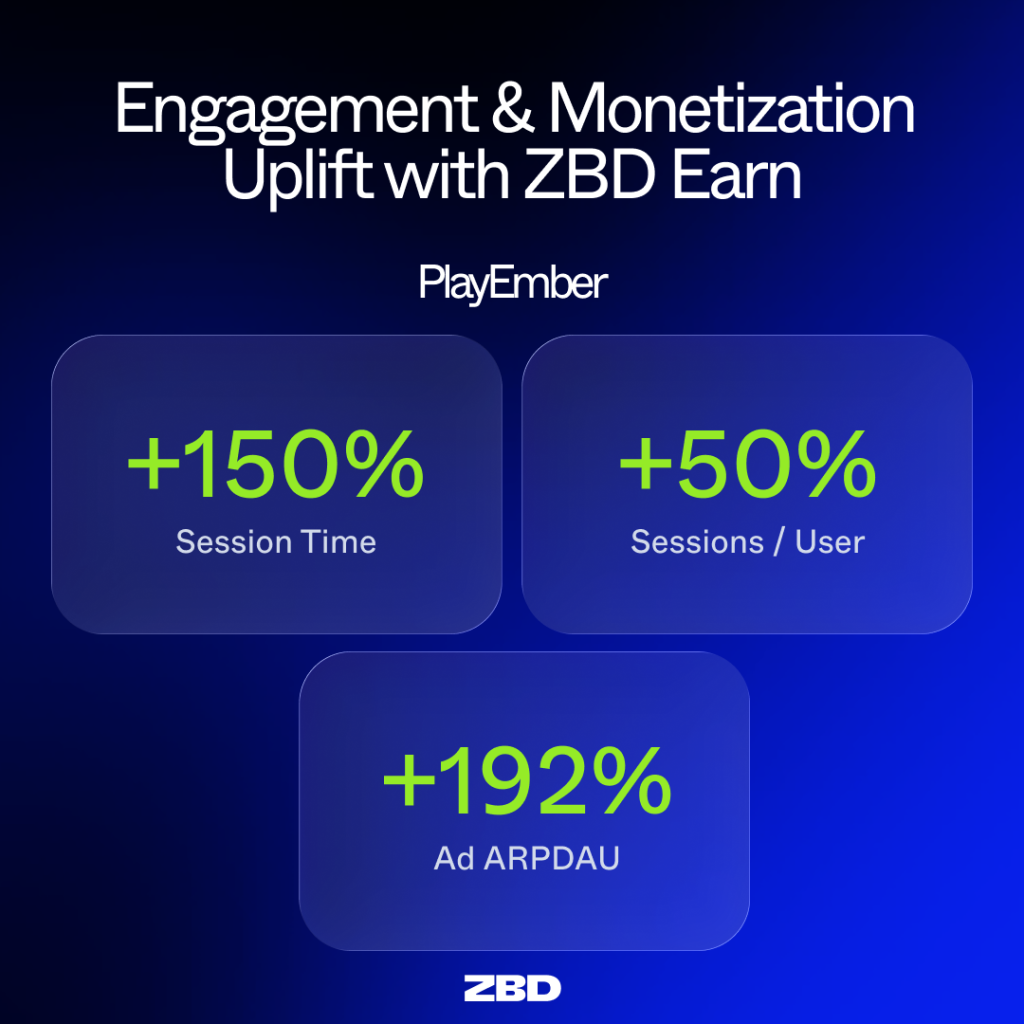
The result is measurable improvements across engagement and monetization metrics, as seen in one of PlayEmber’s titles, where session time increased 2.5x, sessions per user rose 50%, and ad ARPDAU grew ~2.9x.
When users are more engaged, they naturally watch more ads, retain better, and progress deeper into the game. Monetization becomes more effective because engagement has improved.
How it creates a compounding effect
The most significant impact of embedded rewards happens when multiple metrics improve. Individually, each improvement is meaningful, but together they compound into larger gains.
In Merge Monsters, stronger retention increased the number of active users. Longer sessions increased ad exposure. Higher engagement improved monetization performance. The end result was a meaningful increase in LTV to fuel the game’s growth.
Embedded rewards can also influence in-app purchase behavior, like it did for a popular idle game by one of our partners. When embedded rewards were added, there was a 4.3x increase in IAP.
How embedded rewards fit into the growth flywheel
Retention, engagement, and monetization move together. When one improves, the others follow, creating a feedback loop that strengthens game growth deeper into the funnel.
Embedded rewards plug directly into that loop. By tying gameplay actions to real-world value, they encourage more frequent play, longer sessions, and stronger loyalty. They’re also highly configurable. Studios can tailor rewards to different player segments, acquisition sources, or engagement levels, ensuring the system supports existing marketing and monetization strategies instead of disrupting them.
The result is stronger retention, higher engagement, and better monetization, driving higher LTV per player. When LTV increases, everything else shifts. Studios gain more control over how fast and how far they can scale, including UA becoming more efficient with ROAS improvements.
Embedded rewards can be applied across games and publisher portfolios of all sizes and can integrate with existing UA and monetization stacks without disrupting core systems.
Curious how embedded rewards could fit into your game’s growth loop? Reach out.